Originally written by Sunny Kim and published in Korean by W Korea on July 23, 2026.
Read the original article: “정체와 돌파가 공존하던 2026 아트바젤 속으로.” (Editor: Yeoul Jeon)
Translated into English by the author.
Back to Basel
Basel in June stood between stagnation and breakthrough, stability and experimentation. With the market sending conflicting signals, I headed to Art Basel. There, Basel’s enduring strength came into view.
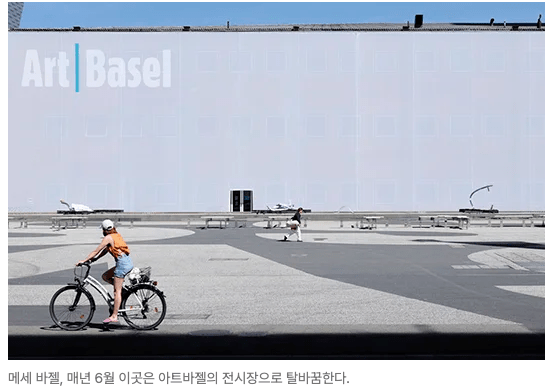
A Market in Flux, a Steady Benchmark
On the weekend before Art Basel opened, the city was strikingly quiet. The Rhine lay under the afternoon sun, while locals stretched out along its banks. Inside the art world, the atmosphere was very different. One question hung over the fair: could this year’s edition shift the mood of a market mired in a prolonged downturn?
Days before the preview, Pace Gallery announced that it was ending its agreements with around 50 artists and estates and cutting roughly 50 employees. The news captured the industry’s predicament with unusual clarity and intensified existing doubts about the sustainability of the mega-gallery model. The city, meanwhile, remained serene, as though none of it had happened.
With geopolitical tensions mounting and the art market still struggling to regain momentum, the fair faced one of its toughest tests yet. Perhaps with that in mind, the fair introduced Basel Exclusive, a new program inviting around 190 galleries in the main sector to unveil selected works for the first time during the preview.
The initiative was met with some skepticism. Works are now routinely circulated, reserved, and sometimes sold by email or private message before the doors even open. Still, the logic was clear: however much the pace of dealing had accelerated, the moment of a work’s first public unveiling could be returned to the physical fair.
The response was stronger than expected. Almine Rech sold a Picasso for between $6 million and $6.5 million, while David Zwirner placed a new work by Elizabeth Peyton for $1.2 million.
On the first VIP day, the aisles were packed. The 2026 edition brought together 290 galleries from 43 countries, visitors from 103 countries, and some 270 representatives from museums and foundations.
Few in the industry disputed that attendance from collectors in the Americas and Asia was down from previous years. Even so, it is still too soon to declare this the “Paris era,” as many have predicted since Art Basel Paris launched in 2022. The density that Basel creates remains difficult to match.
Above all, Basel does not lend itself to a one-day visit. Many visitors return several times over the course of the week—evidence that the fair still functions as more than a marketplace.
Basel has always been a stage for the masters, but familiar names carried unusual weight. Picasso, Gerhard Richter, Bruce Nauman, and Willem de Kooning were given pride of place in the booths of the mega-galleries. Collectors, too, seemed to gravitate first toward proven names rather than new possibilities.
The figures bore this out. Hauser & Wirth recorded two of the fair’s highest reported sales, placing a Picasso for $35 million and a Gerhard Richter for $20 million.
“This year’s sales make it clear why people still say, ‘Basel is Basel,’” said Hyewon Kwon of Gallery Hyundai’s exhibition team. “At the same time, the dominance of blue-chip sales suggests that collectors are making safer choices than ever. The tendency is not new, but it was far more pronounced this year. In an uncertain market, the pull of proven names has only grown stronger.”
Gallery Hyundai, too, centered its booth on established masters of Korean modern and contemporary art, including Seundja Rhee, Chung Sang-Hwa, and Lee Kun-Yong. Of the seven artists presented, the youngest was painter Kim Minjung, born in 1962.
Visitors naturally gravitated toward Unlimited, Art Basel’s signature sector for large-scale projects. The most visible change was the appointment of MoMA PS1 curator Ruba Katrib to lead the sector.
Where MoMA has long been associated with major exhibitions centered on canonical figures, MoMA PS1 has built its name by championing experimental artists and new ideas in contemporary art. Katrib has likewise brought sustained attention to voices outside the institutional mainstream. Her curatorial perspective was shaped throughout Unlimited, perhaps the sector’s most diverse edition yet.
Katrib framed the edition around “monumentality.” Moving between installation, sculpture, performance, video, and immersive environments, the presentation treated monumentality not simply as spectacle, but as a question of what forms and sensibilities art might need to reckon with the present.
At the entrance, Chris Burden’s police-uniform installation L.A.P.D. Uniforms (1993) set an imposing tone. Thomas Ruff’s use of images from the September 11 attacks offered a chilling reflection on how memory is consumed in the media age. By contrast, works by Alfredo Jaar, Kim Bohie, and Yayoi Kusama pointed beyond tragedy and noise toward healing and recovery. Despite their different media and visual languages, a shared question emerged: how are we to remember—and endure—the world as it is today?
Zero10, making its European debut in Basel, marked another step in Art Basel’s evolution. The new sector brought digital art, generative AI, and cross-media projects firmly into the fair’s official program. William Mapan’s algorithmic paintings were among the standouts, which probe the shifting boundary between human and machine authorship.
Parcours carried the fair out into the city. Under the theme of “living together,” cafés, bars, parks, and other everyday settings became stages for art. Following the route brought visitors through to restaurants, public squares, and other exhibitions along the way. Before long, a guidebook opened to find the next artwork had become a map for choosing the next place to go.
Beyond the Messe
Basel Art Week would be incomplete without Liste Art Fair. Founded in 1996, the fair has built its identity around emerging galleries and younger artists. For those looking beyond established names to the possibilities of the next generation, it remains an essential destination.
Galleries may participate in up to five editions, and many later move on to Art Basel after finding their footing at Liste. Its reputation as a gateway to Art Basel is well earned.
For its 30th anniversary, Liste brought together 105 galleries from 36 countries. Asian galleries were especially visible, with a particularly strong presence from Southeast Asia. Seven galleries came from Korea—A-Lounge Contemporary, Sangheeut, Shower, Cylinder, G Gallery, Primary Practice, and Whistle—making Korea the second-largest national presence at the fair. Galleries from Bangkok, Jakarta, and Guatemala City were also among the participants, showing that Liste continues to draw new regions and new generations into its orbit.
“We sold most of the works to European collectors,” said Dooyong Ro, founder of Cylinder, participating in Liste for the third time. “What surprised us was that 70 to 80 percent of them were Swiss. Many collectors seemed less concerned with scale than with finding works that, even when modest in size, could sit comfortably within their existing collections.
“There was a time when experimentation at Liste often seemed to serve as proof of youth. Now, I feel it is becoming a fair where experimentation and commercial viability coexist much more naturally.”
As dusk fell, people who had spent the day scattered across the city began streaming toward Basel SBB station, as if following an unspoken cue. Their destination was Basel Social Club, now in its fifth edition.
Under the theme, “Office,” a vacant office building near the station was transformed into an exhibition venue. After occupying a former factory, a farm, and a bank in previous years, the event moved into a vast office block, turning it into a setting where exhibitions, bars, performances, intense debate, and encounters overlapped. Co-founder Robbie Fitzpatrick described the platform as “a space that offers a new generation of collectors a far more relaxed and open point of entry than a traditional art fair.”
Throughout the week, the program moved between exhibitions, performances, an art book fair, meditation, personal training sessions, and DJ parties in the underground car park. Yet for all the choices on offer, every route seemed eventually to lead to the ground floor courtyard.
Beyond the lobby, where an installation bears Maurizio Cattelan’s unmistakable humor, the courtyard opened onto a dense crowd. Unexpected reunions unfolded alongside new connections. Conversations began easily, even between strangers, and exchanging Instagram handles feels more natural than posing together for a photograph.
One introduction leads to another, and the distinctions between gallerists, artists, collectors, professors, students, and designers gradually begin to dissolve. Conversations continued late into the night, only to resume the following day after another chance encounter at a different exhibition.
During Art Week, Basel Social Club opened at 4 p.m. and closed at 3 a.m.—a schedule that closely followed the daily rhythm of the art world itself. The daytime was spent moving between fairs and institutional exhibitions; by evening, people gathered in this shared meeting place. In the end, the real center of Basel Social Club was not its program, but its people. As Basel native Luke Fitze, who leads strategic partnerships at the media art studio iart, put it: “What makes Basel Social Club special is the sincere and intimate community it has created.”
How a City Becomes a Platform
What happens inside the Messe explains only part of Art Basel’s enduring position in the global art market. Basel Social Club offers a different part of the answer. By lowering many of the barriers associated with traditional art fairs, it gives emerging galleries and younger artists a chance to reach an international audience.
For students at local art schools, including the FHNW Academy of Art and Design, the event is an opportunity to present their work to visiting curators, collectors, and other figures from across the international art world. The programs unfolding throughout the city also depend on the voluntary participation of local residents, cultural institutions, and an extensive network of volunteers.
Global companies play an important role, but rarely place their brands at the center. A sofa one sits on without much thought turns out to be by Vitra; an artwork rests on a USM modular system.
Locals sometimes joke that Basel is “a quiet city where everyone seems to work for a pharmaceutical company.” Once Art Week begins, however, it becomes clear how schools, institutions, businesses, and residents have each contributed to building Art Basel in their own way.
Opinions on Basel’s position in the market remain divided. What I saw on the ground, however, looked less like a market in decline than a platform moving into its next phase. A day that began at the Messe flowed naturally into museums, Liste, and Basel Social Club. Along the way, a sale often became the beginning of another meeting or project.
Art Basel’s value cannot be measured by sales alone. It lies in the city’s ability to weave an entire week into a single experience. Markets change. That ability is not built overnight.
 Mikynnus